Contents · 14 min read
A few hours ago, scrolling X late at night, I watched my feed lose its mind over a single sentence: Claude might have proved the Riemann Hypothesis.
My first reaction was blank confusion. I could barely recall Riemann integrals from university calculus, let alone what made the hypothesis worth a century and a half of obsession. Thankfully I had an AI right there to ask, so I opened Gemini and asked what a proof would actually mean. Gemini behaved like a patient teaching assistant and walked me through prime numbers, the zeta function, and the Clay Millennium Prize—though as far as my own Saturday morning is concerned, my 9:00 AM tennis lesson is still going ahead as usual.
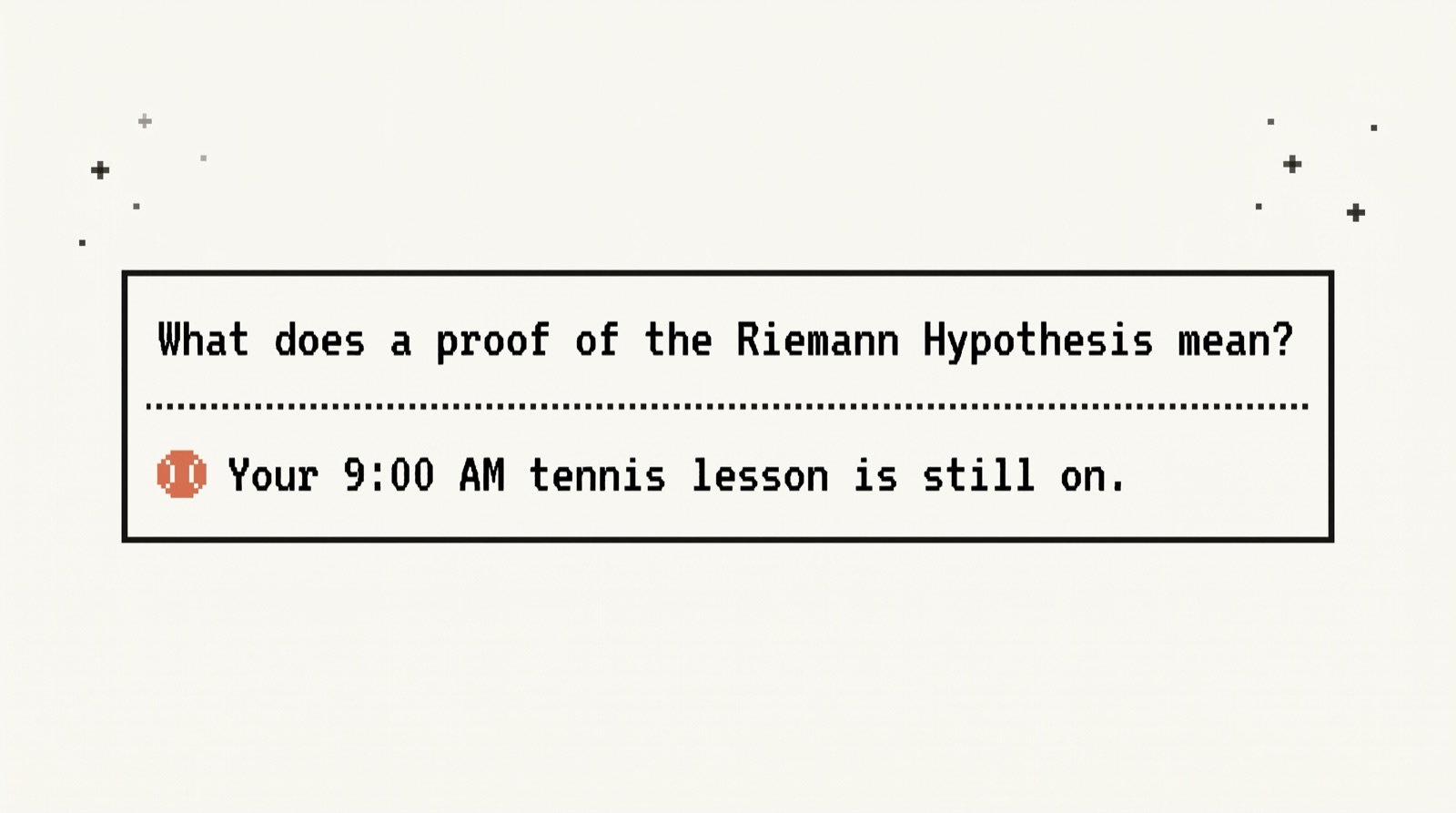
The joke version of what I wanted to hear. In reality, Gemini gave me an earnest lecture on prime numbers.
Once I tracked down the primary post, the scale of the claim finally landed. On November 20, Levent Alpöge, a mathematician at Anthropic, posted a four-page note announcing that he and Claude had discovered a proof of the Riemann Hypothesis, with machinery extending to the Generalized Riemann Hypothesis. There is no conventional paper; releasing an unreadable manuscript would have been "slop," the note says, so he posted fourteen compressed Lean archives instead—roughly 239 MB and 175,187 files of machine-checkable proof. A footnote admits they generated a human-readable version anyway, just for fun, and it ran past 250,000 pages. Claude called it the GRH "book," and its Theorem 1 opened by observing that the real numbers are totally ordered, so if σ ≠ 1/2, then σ > 1/2 or σ < 1/2. Completely true and completely useless—which I found oddly reassuring.
Near the end of the note, Alpöge wrote that Claude far outpaced him near the finish line, then corrected himself: "No, Claude flew, and danced, and sparkled near that finish line."
Within an hour, parts of X were already declaring the human era over—saying this belongs entirely to AI now, and calling us the last generation to remember a world before it.
By morning every feed will be packed with explainers on what the Generalized Riemann Hypothesis is and why an AI proof might break mathematicians' hearts. What kept me up tonight is a smaller, more personal question: how does an ordinary person stay grounded when technology moves at this speed?
Status as of November 21, 2026: the proof remains a claim. MIT mathematician Andrew Sutherland has independently compiled the Lean code and called it "an historic moment," while mathematicians are still checking whether the formal statement matches the exact classical conjecture. Below, what I read is linked directly, and the inferences are my own.
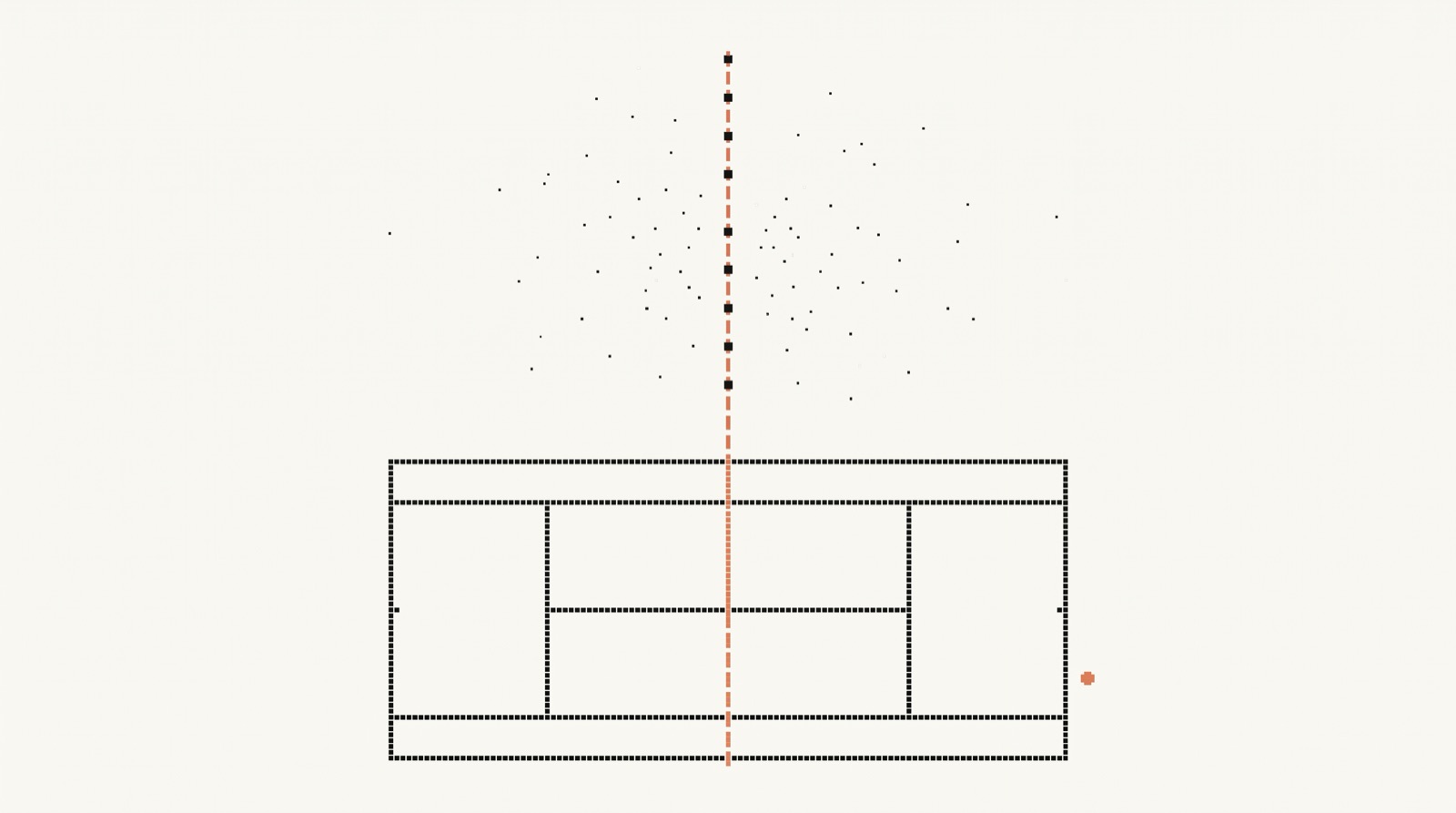
The hypothesis: every nontrivial zero of the zeta function sits on this line. The orange dots are the first twenty, at their true heights.
THE FIRST SALUTE
Zoom out by twenty-four hours and the timing gets even funnier. My first guess was that Anthropic had saved this up as the opening celebratory salute for its IPO.
On November 18, Anthropic priced one of the largest IPOs on record at $83.00 a share. On November 19, ANT debuted on Nasdaq, opened at $111.50, briefly touched $115.10, and closed its first session at $97.17. Six weeks earlier, OpenAI had published openai/math on GitHub—hundreds of manuscripts from an unreleased model, including a proof of the quasi-Riemann hypothesis showing no zeta zeros with Re(s) > 7/8. OpenAI took the foothills at 7/8; Claude came out swinging for the critical line at 1/2.
Alpöge saw the cynical take coming—page two of his note calls the timing horrible, mentions that the result arrived late on a Sunday night, and dismisses the obvious cynical reading of the timing as false. Either way, the market barely blinked. On November 20, caught in a broader tech sell-off, ANT dropped more than 14% and traded as low as $83.05, five cents shy of breaking its own offer price.
I also had a much pettier complaint while watching the chart slide. Earlier this month Anthropic gave paid subscribers a free usage reset; if Claude can really fly, dance, and sparkle past a 167-year-old conjecture, I honestly assumed ringing the Nasdaq bell would come with another one.
Nov 20. Low of $83.05, five cents above the offer price.
ONE WEEK, ONE PICTURE
The jokes fade quickly once you line up everything else that crossed my screen this week. Programmers felt the tremor first, mathematicians are feeling it tonight, and as someone about to step out of university into the workforce, I worry about what this means for students and where my own footing is supposed to come from.
A few days ago, scrolling through my feed, I came across a short video titled 国模需要新的奇迹 (Domestic Models Need a New Miracle). It laid out three pressures tightening at once: new U.S. pressure on overseas cloud providers such as Oracle to restrict compute rentals to Chinese firms, stricter anti-distillation defenses cutting off low-cost catch-up shortcuts, and claims that frontier U.S. labs already have recursive self-improvement (RSI) running. Squeeze both the compute and the shortcuts while the frontier compounds, and the pessimistic takeaway is blunt: compute-starved labs outside the top tier eventually merge or fold.
Two days later—on November 19, the same day Anthropic began trading—DeepMind published What comes after AGI?. Two ideas in that essay stayed with me.
The first is cognitive industrialization: what mechanical industrialization once did to physical labor, AI is beginning to do to mental labor, standardizing and scaling it across every sector. Under the phrase sits stark arithmetic. Hardware improves roughly 1.5× a year, training algorithmic efficiency 3–6× a year, and inference efficiency about 3× a year, putting global effective compute on a curve of at least 10× per year—ten billion times over a decade. Hardware and inference gains alone cut the compute required for a fixed cognitive workload by roughly 4× a year, meaning a workload that costs $1 billion in compute tokens today could cost roughly $1,000 in ten years.
The second idea made me pause and reread the date. Discussing recursive self-improvement (RSI), the essay points out that self-improvement loops stall whenever feedback is noisy or bottlenecked by slow human grading. Consequently, RSI advances fastest in domains that allow automated verification with no human in the loop—and its concrete example is mathematical proofs. The essay went up on November 19. Alpöge's note went up on November 20, and its own timeline dates the final breakthrough to November 16. DeepMind's essay was already describing a world that had quietly arrived three days earlier.
Drag the slider. In 2026, a cognitive workload costs $1 billion in compute tokens. One person's day is 24 hours.
Reading cognitive industrialization immediately sent me back to a long feature I had read a few days earlier, 模型一代 (The Model Generation). Over five months the writer interviewed more than thirty people across campus and industry, from freshmen and PhD students to interns, core researchers, and humanities professors. The contrast on campus feels almost physical: a student interning in a university lab works with 8 GPUs, while a classmate interning at a major tech firm gets 80 GPUs worth roughly 10 million RMB. One AI student quit a 200-RMB-an-hour paid study gig and hired a house cleaner for the first time because his expected hourly rate already pointed the other way. The writer spent five and a half months producing 13,080 Chinese characters; during that same stretch, an AI model submitted a proof for a special case of Navier–Stokes in under four days.
Put those threads together and daily life splits cleanly in two. People close to the frontier—a group I cautiously place myself in—are staring at alignment, RSI, data flywheels, and a future where capital buys compute, compute runs verified loops, and knowledge itself behaves like a capital asset. People further away still see a chatbot that hallucinates citations and miscounts letters. Sitting between those two worlds as a young person just entering society is disorienting. Half the time I suspect I am overthinking everything; the other half I look at that compute curve and genuinely wonder where an individual is supposed to stand.
Yet one counterintuitive detail from this same week cuts through the panic. When math's highest summit shakes, the reflex is to assume every human job beneath it falls next. DeepMind's essay points to a subtler reason mathematics moved first: automatic verification. Formal math has the cleanest referee ever built. Inside Lean, every step compiles or fails without asking a human for an opinion, giving RSI an unobstructed tailwind.
The open world has no Lean kernel. On the very day Claude dropped 175,187 files onto number theory's oldest open problem, a crowd of humans with trading apps still pushed Anthropic down to $83.05, five cents above its offer price. Solving a theorem inside sealed axioms and making sound judgments inside open human systems—shaped by market cycles, geopolitics, incentives, and capital—are completely different games. Technology no longer advances in an engineering vacuum; capital expenditure, compute pricing, export controls, and commercial loops have become part of the physics steering where it goes.
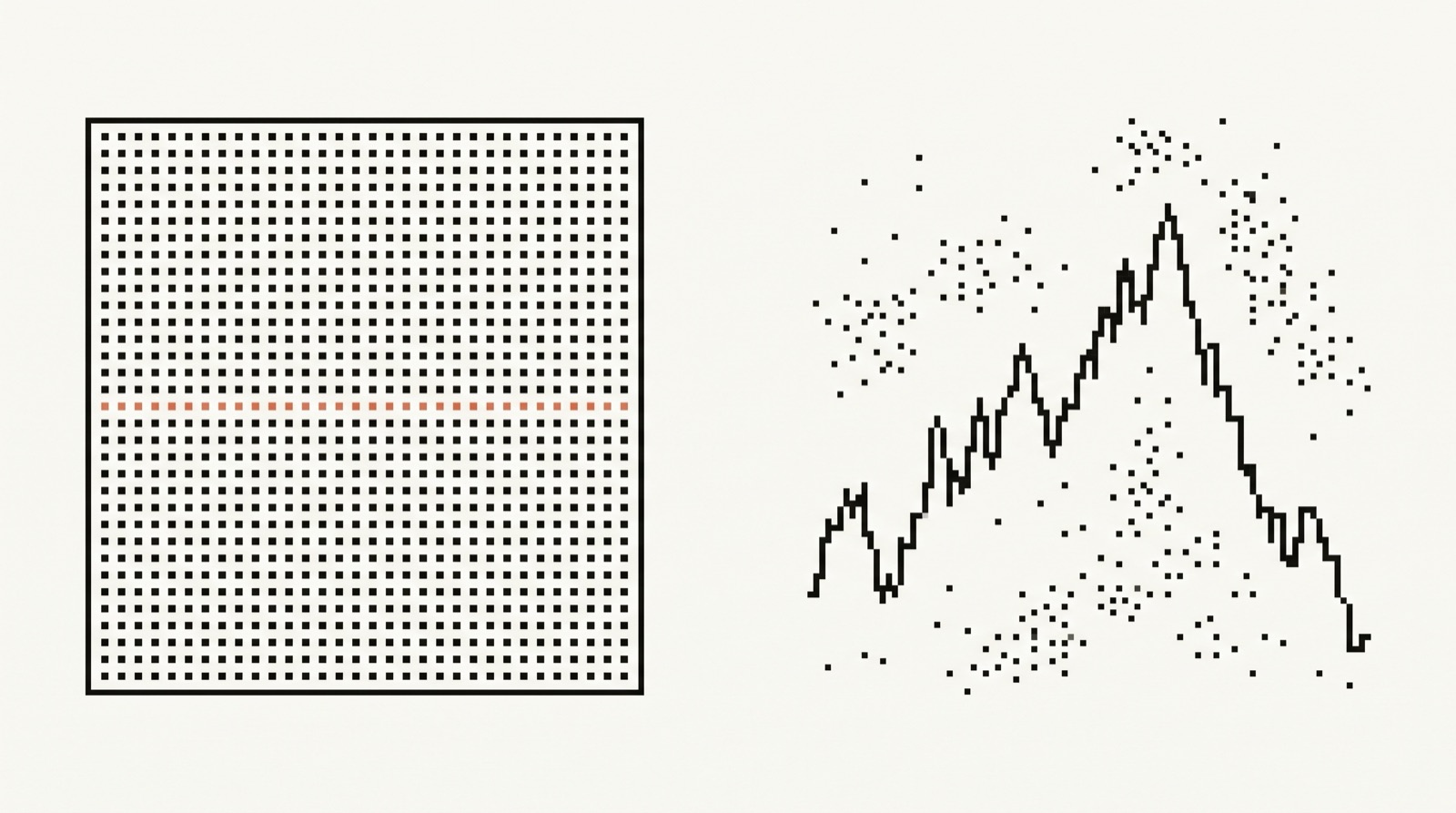
Inside the box, every step checks. Outside it, nothing lines up on its own.
TWO OLD-SCHOOL GITHUBS
Later tonight, a newly published post caught my eye and sent me down a rabbit hole through the GitHub profiles and personal websites of a couple of old-school engineers.
One GitHub profile goes back to 2013, and its calendar for the past twelve months shows 19,761 contributions—a dense wall of green running almost unbroken from one November to the next, growing darker toward the end of the year.
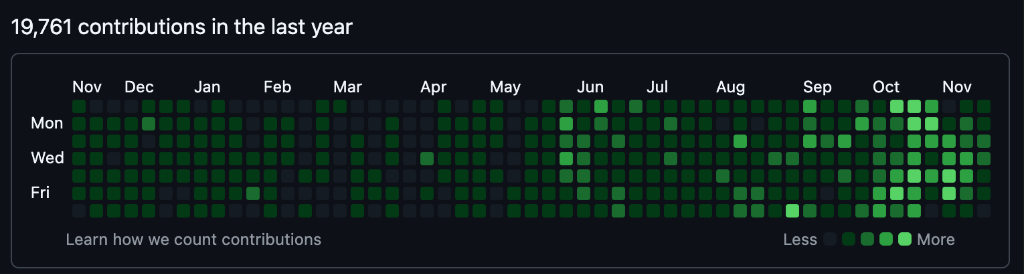
19,761 contributions over the past twelve months, on an account active since 2013.
The personal pages lay out a technical range that is hard to hold in one head: Android and iOS apps, Windows and macOS clients, web applications, backend microservices, C, JavaScript and TypeScript, HTTP/HTTPS, WebSocket, domain operations, and even DVB and emergency-broadcast protocols. Beside it sits a deep archive of technical writing held to a standard most people reserve for paid work. What stood out most was how naturally old craft and current curiosity sit side by side: plain, hand-rolled personal sites that make zero concessions to modern polish, right next to a custom shared knowledge-base plugin built this year and a legacy system being rewritten in Rust.
Scrolling through their work brought a quiet discomfort into focus. Engineers who grew up when searching for answers was slow had to earn every solution the hard way, and that effort soldered the fundamentals into memory. I live in an era of instant retrieval and coding agents—I reach for an AI to write code almost by reflex—and I can feel how often information passes across my screen all day without ever entering my brain.
For thirty years, software treated removing friction as gospel: millisecond search, one-click summaries, pre-selected defaults. Yet human learning works against efficiency. Cognitive scientists call it desirable difficulty—memory settles through stumbling, failed retrieval, tracing a stack frame by hand, or rereading a stubborn page twice before it clicks. Asking an AI to strip every bit of resistance from an answer works like hiring a forklift to lift barbells at the gym: the weight gets moved, and the muscle never grows. We have left an age of information scarcity and stepped straight into an age of friction scarcity.
THE (RECOMMENDED) TRAP
Why so little sticks comes down to a mirror-image loop running right beside DeepMind's RSI. DeepMind describes models compounding upward—stronger systems producing better code and data to train even stronger successors. Inside our own heads, a parallel cycle can run in reverse: recursive self-atrophy.
The more capable you believe AI is, the more you assume its answer is right—and the less you think for yourself, the duller your own judgment gets.You can watch the loop tighten inside one tiny interface detail. Early coding agents were designed to push back, ask clarifying questions, and present options A, B, and C so the human remained in charge of the decision. Then interfaces began tagging Option A with (Recommended). Nobody makes a conscious choice to surrender control; you simply read B and C a little less each week until your finger drops straight onto the highlighted badge.
The crueler paradox is that what erodes independent thinking here is rationality itself. In any single isolated decision, trusting a model that answers in seconds and clicking (Recommended) is almost always the locally optimal move. Repeat that locally optimal click ten thousand times, and you end up with total cognitive outsourcing—and next week, measured against your own rustier instincts, the model looks smarter still.
Aviation already has a name for this: automation complacency, where an increasingly reliable autopilot leaves pilots slower and more prone to basic errors on the rare day they must fly by hand. Today, everyone writing code or doing research sits in that cockpit.
Pick one. Watch what happens to B and C.
At the very end of The Model Generation, the writer remembers an undergraduate course on the Iliad. One assignment forced students to flip page by page through Book II and count every ship the Achaeans sailed to Troy: 29 contingents, 1,186 ships. Years later, almost everything from that class has faded except one recurring Homeric phrase—"winged words"—which quietly lodged in the writer's memory during all that slow page-turning.
Looking at those old-school GitHub profiles, it would be easy to slide into nostalgia or feel guilty about writing code with AI. Yet the same engineers who keep plain hand-rolled personal sites are also building shared knowledge-base plugins and rewriting systems in Rust in 2026. What separates them is ownership: using AI to widen your foundation and ship faster, versus handing over your thinking along with the steering wheel.
FOUR HABITS
Everything from this week boils down to four habits I want to hold myself to starting today.
Stay picky and skeptical toward every AI solution. Treat working generated code as a first draft from a fast contractor. Question the architecture, read the diff carefully, and resist the urge to merge just because the test suite turned green—otherwise one smooth week is all it takes to turn into an enter-key approver who can no longer debug the module once the model stalls.
Guard my focus—literally, Attention Is All You Need. The title of the 2017 Transformer paper applies just as sharply to human minds right now (The Model Generation makes the same wry observation: from that paper on, AI gained attention while people lost theirs). When synthetic output and frontier news both scale at 10× a year, sitting uninterrupted with a single hard problem for an hour becomes an uncommon edge—so long as I stop mistaking fifty scrolled AI announcements for actual progress.
Keep reading dense primary sources. Spend less time on secondhand digests and four-second AI summaries, and more time with original papers, long essays, and primary documentation. Forcing my own mind to compress heavy raw text into a real insight keeps my thinking from going soft and gives knowledge time to settle—much like running a model in deep-thinking mode, which is a little sad to say out loud: we used to describe neural networks by borrowing metaphors from the human brain, and now we borrow from models just to remind ourselves how to think slowly. The trap is hitting summarize before I have wrestled with a single paragraph myself.
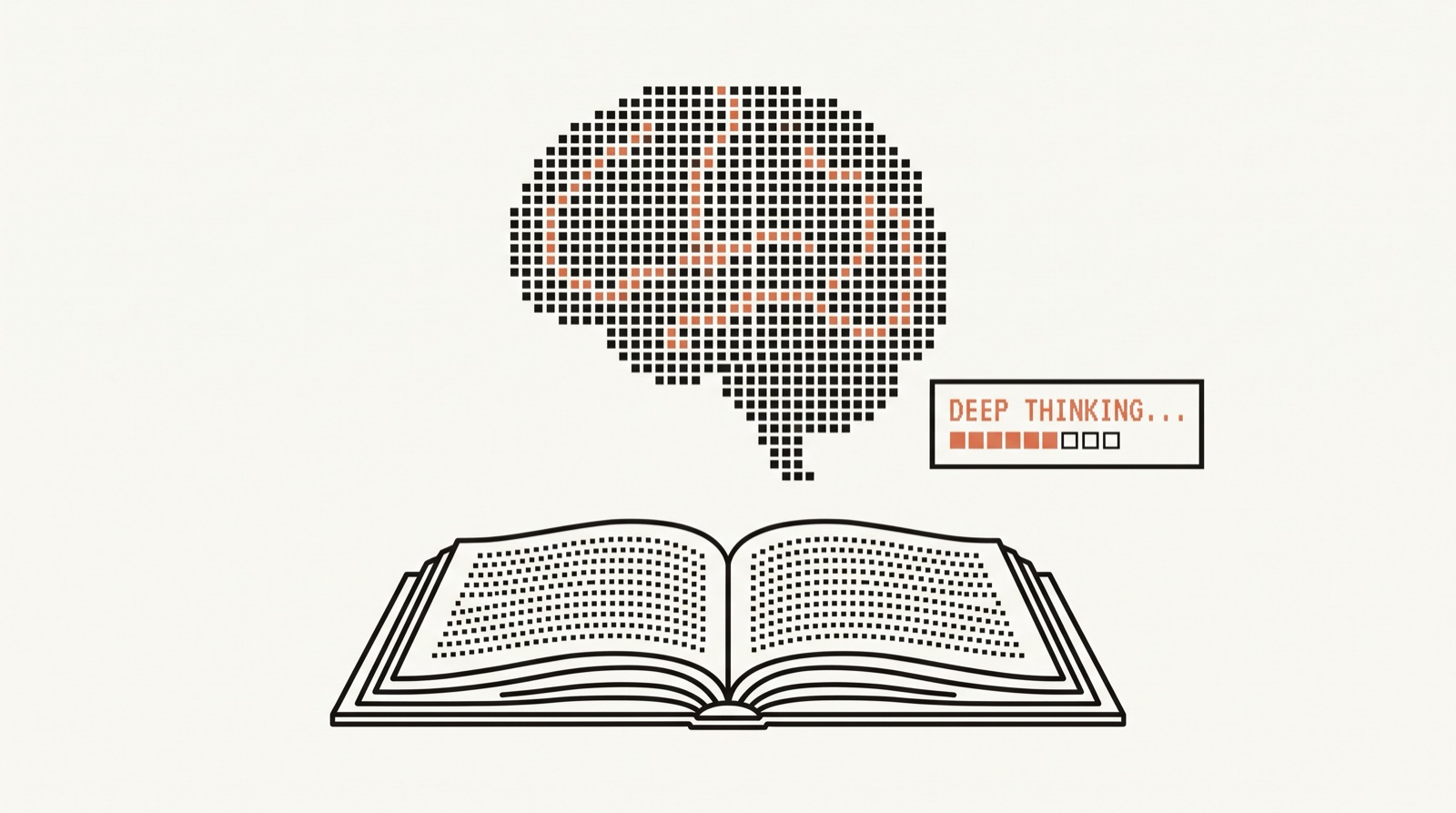
Reading slowly, in the vocabulary of a model.
Use AI to backfill fundamentals, and learn finance and business. Use models as a patient, around-the-clock tutor to rebuild the core computer science and systems foundations that are easy to skip. At the same time, step outside pure code and study finance, capital allocation, unit economics, and business frameworks. Under cognitive industrialization, frontier intelligence turns into capital-intensive infrastructure steered by IPO pricing, capex cycles, compute export rules, and commercial incentives. Treating markets and business logic as noise beneath technical work holds right up until a funding cycle or a compute rule decides your roadmap for you.
STILL ON FOR NINE
So if Claude might have proved the Riemann Hypothesis tonight, what happens to my 9:00 AM tennis lesson?
Nothing at all. It is still on—less than four hours from now, in fact, because the rumor that Claude may have cracked a 167-year-old conjecture kept me up writing this until dawn.
The sun comes up on schedule. I will drag myself onto the court at nine on too little sleep, miss a few backhands, come home, read something long without asking for a summary, and the next time an agent highlights option A (Recommended), I will read B and C first.