Contents · 15 min read
On September 30, 2026, the root commit of ewanlab landed at 23:03 (b768405). I had started an afternoon session in the Codex app to scaffold an Astro project. It began as a portfolio for job hunting, but quickly turned into a search for a visual identity I could not yet name.
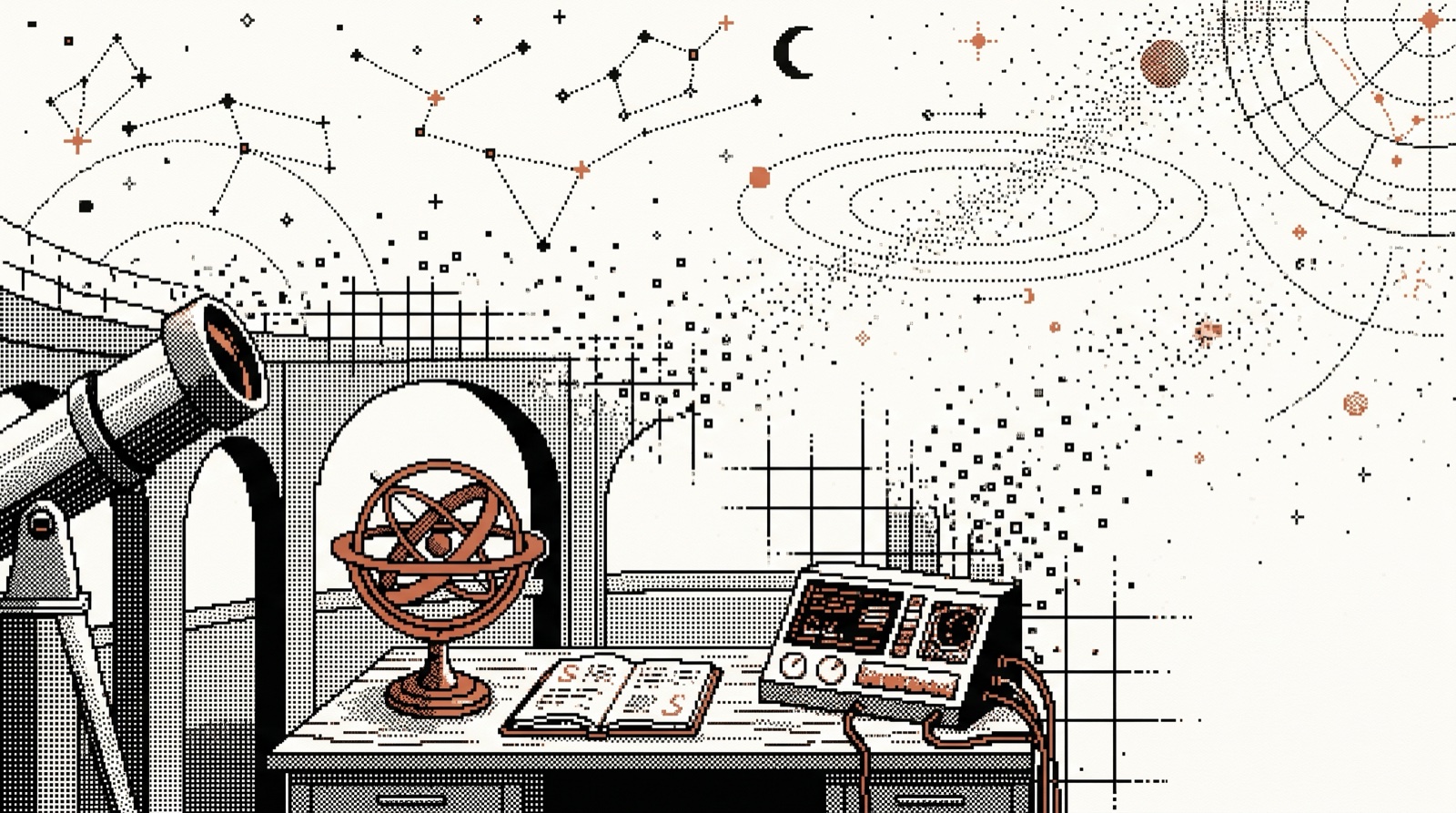
I surveyed developer sites and designer portfolios. Most developer sites hung courses and paid knowledge on them. Designer portfolios offered clean visual rhythm, but rarely exposed the technical machinery underneath. When OpenAI released GPT-6 Astra, its celestial particle motion immediately stood out. The astronomical theme felt right: a personal observatory seemed like the right metaphor—a quiet space to observe ideas in orbit, test agent systems, and record daily work.
I began with Codex because I held an active subscription, and its tooling supported end-to-end execution. In interactive mode, Codex could draft Astro templates and TypeScript modules, maintain an interactive browser preview in its side panel, configure Vercel deployments, and call image generation models directly through its command-line interface. At the time, I assumed that building a site with this degree of automation meant only providing clear prompt descriptions.
THE START
Building a personal observatory turned out to require more than prompt engineering. The code landed quickly, but the visual soul was missing. What followed was a month-long pursuit of an aesthetic I could recognize when I saw it, but could not describe in advance. On October 1, Look 2 replaced Look 1.
THREE ABANDONED LOOKS
Between September 30 and October 26, the site went through three complete aesthetic overhauls before arriving at its final design.
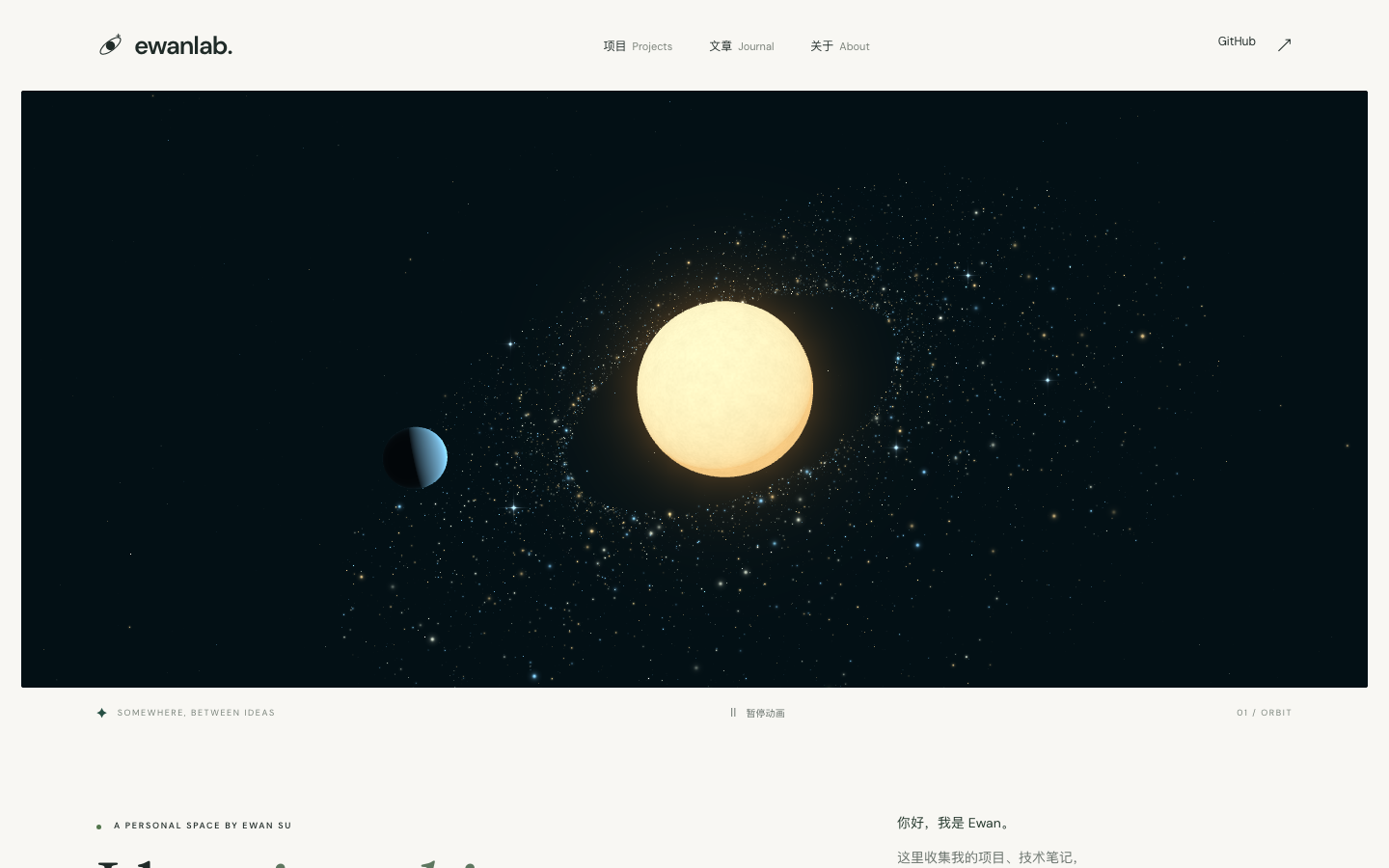
Look 1 (b768405, 2026-09-30): A light background with serif headlines, bilingual labels, and a top 3D yellow sun banner.
The first iteration arrived at commit b768405 on September 30 under the title "Ideas in orbit." It was generated without detailed visual guidance. The result was a raw sketch: a light paper background, a top banner featuring a 3D yellow star in deep space, bilingual English and Chinese navigation pills, and two project cards illustrated with schematic green candlestick charts. It looked like an uncommitted draft.
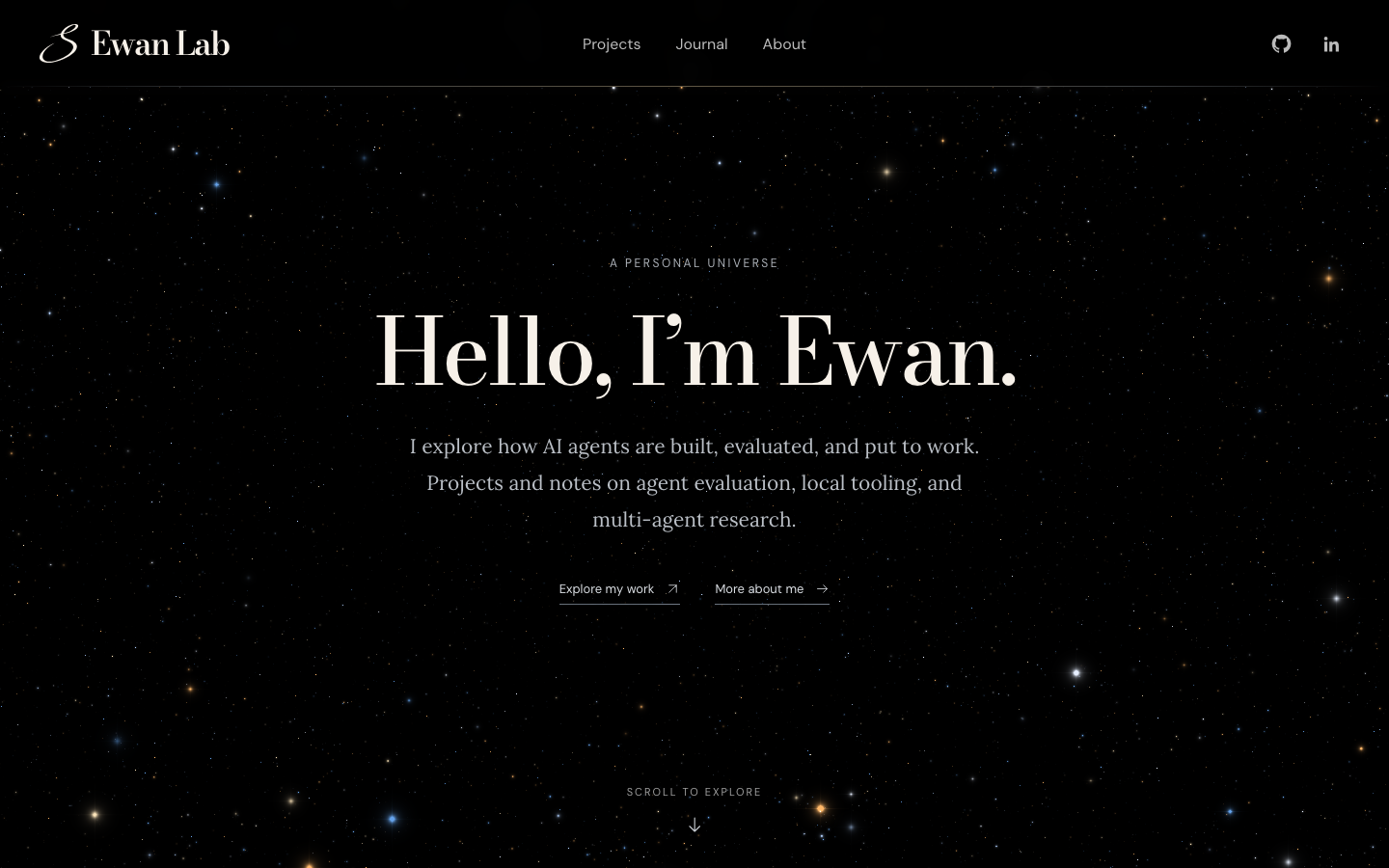
Look 2 (190289d, 2026-10-04): Pure black celestial canvas with glowing planetary cards and Bodoni serif typography.
On October 1, I rebuilt the interface around a pure black cosmic canvas at commit d42d061. The home page introduced an interactive galaxy canvas and a click-to-enter lunar entrance. On October 3, project cards were revised into animated celestial bodies with faint border glows (46c966d). By commit 190289d on October 4, the layout had converged on an all-English interface with a Bodoni serif headline reading "Hello, I’m Ewan." It looked visually dramatic, but the cosmic particle animations and glowing borders created too much visual noise, competing with the text until my eyes swam.
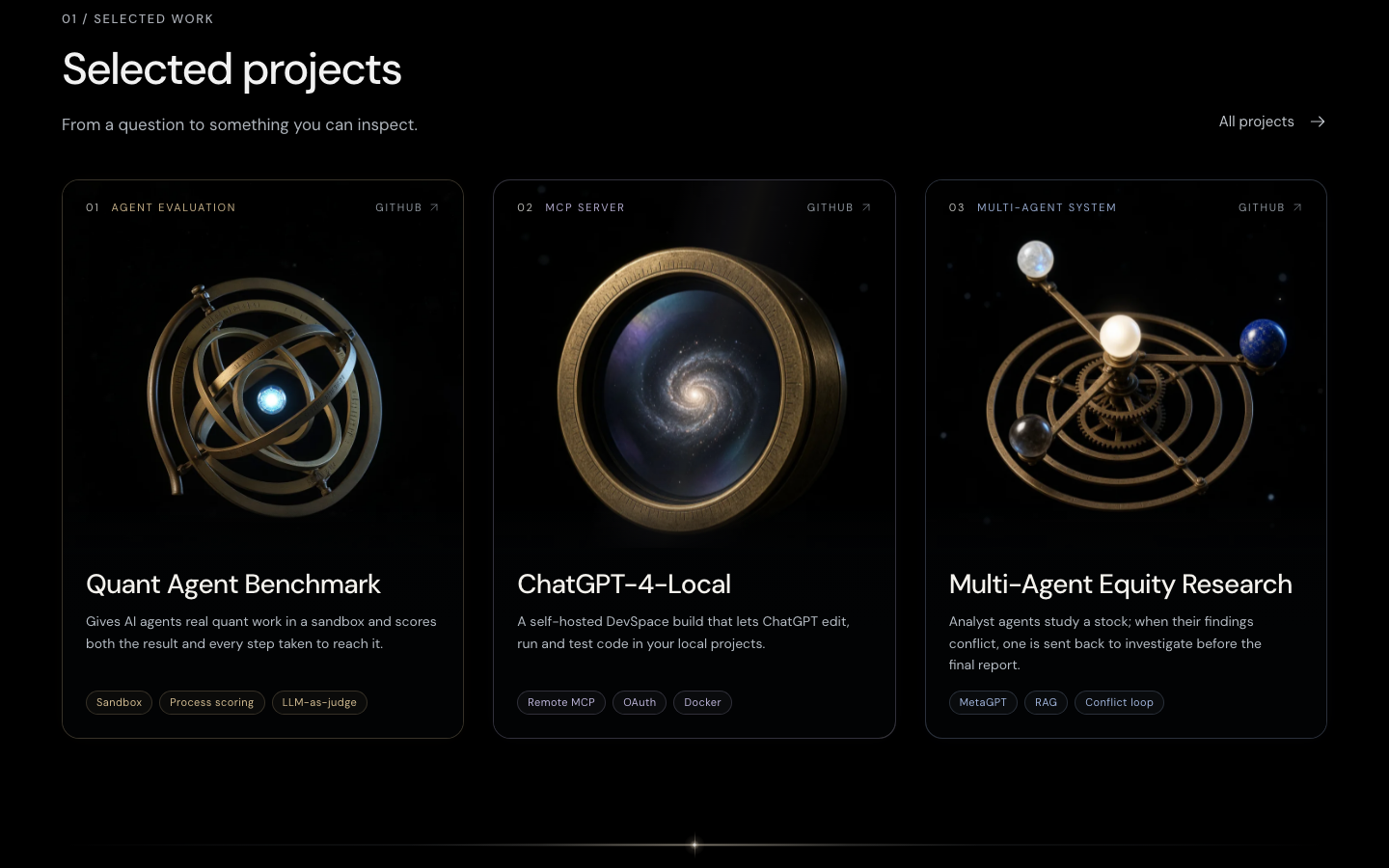
Look 3 initial state (cdc464b, 2026-10-05): Antique brass instrument still lifes, pill tags, and central diffraction star dividers.
On October 5, my Codex subscription expired. Claude Code had recently gained prominence with the release of Opus 5.5, prompting me to migrate the repository (c82bf19). Lacking native image tools inside Claude Code, I used Grok to generate photographic still lifes of antique brass instruments—an armillary sphere, a telescope objective, and an orrery—paired with glowing diffraction star dividers (cdc464b).
This workflow quickly stalled. Grok's image generations lacked photographic realism and drifted into generic digital wallpaper. I moved back and forth between the two tools, and context didn't carry over. The brass instrument cards felt disconnected from modern software engineering. I spent days generating candidate images only to accumulate visual clutter.
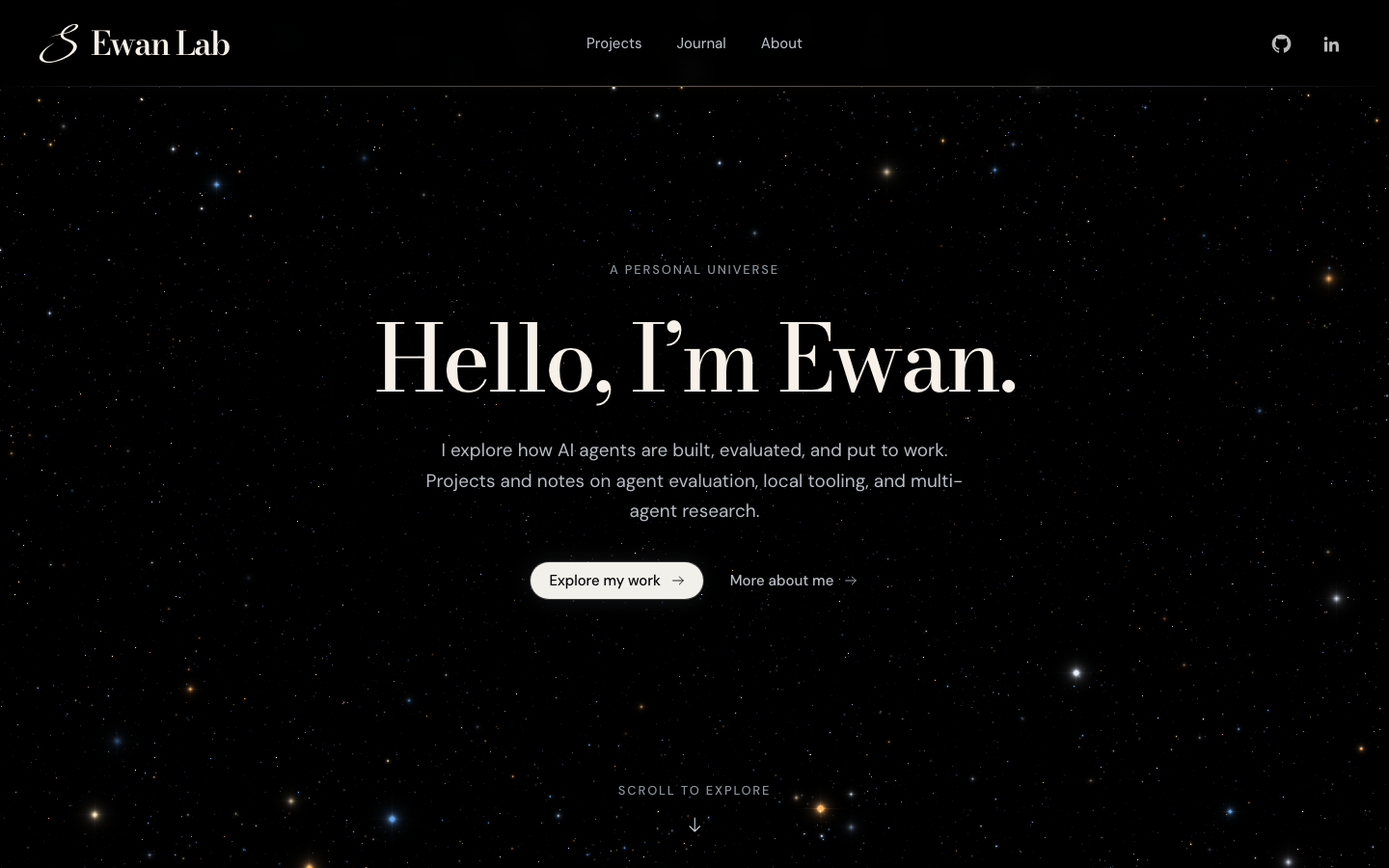
Look 3 typography convergence (df1375f, 2026-10-10): Alignment along a single vertical axis with DM Sans for interface and Lora for text.
On October 10, Claude Code cleaned up the typographic hierarchy across commits 12c98be and df1375f. We eliminated monospace fonts from primary copy and established two clear typographic voices: DM Sans for interface headers and Lora for reading text, aligned to a single vertical axis. The structure was orderly, yet the heavy cosmic theme remained tiring to browse.
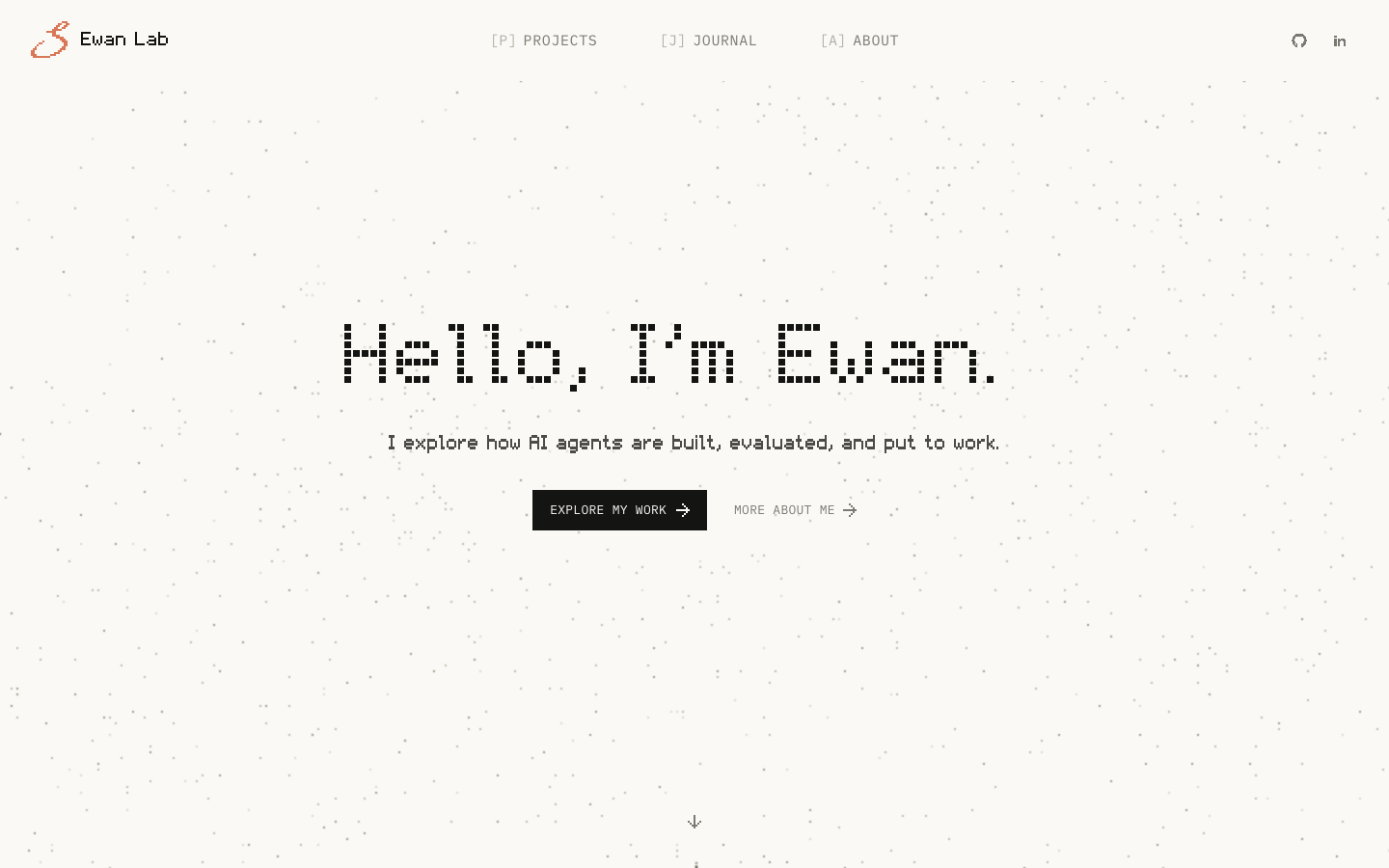
Look 4 on 2026-10-27, before Atlas (9ebb1e2): Warm paper background (#faf9f5), terracotta accent (#d97757), and custom bitmap pixel typography inspired by claude.dev.
The decisive pivot occurred on October 26 at commit 9a1b3a0 (merged in 99324ca). I frequently browsed claude.dev and appreciated Anthropic's editorial presentation. I realized that instead of struggling to generate realistic photographs through third-party image models, Claude Code could generate clean SVG and canvas graphics directly in code.
We redrew the entire site in a warm palette: a paper background (#faf9f5), warm black text (#141413), and a single terracotta orange accent (#d97757). The cosmic theme was translated into a discrete 2D dot-matrix sky canvas and custom bitmap typography. The contrast was immediate: the dark cosmic layout had been visually dazzling but hard to read, while the warm paper aesthetic combined visual restraint with comfortable legibility.
I read a post on X that put it this way: OpenAI models behave like a loyal employee, compliant and strictly obedient to prompts; Anthropic models behave like a picky partner or auditor, inspecting work from an equal or higher vantage point, sometimes scrutinizing every detail like a judge.
That distinction matched my experience. Claude's strictness appeared during conversation and design discussions, challenging structural premises and pointing out aesthetic inconsistencies. GPT models after version 5.6 expressed strictness primarily through voluminous guardrail code. (I do hope GPT finds its edge and overtakes Claude again soon—competition is what keeps these models honest, and I miss having that horse in the race.)
This transition revealed an important property of design with agents: visual taste has two halves. The first half is translating a vague aesthetic preference into concrete code. The second half is inspecting a screenshot of that code in a browser and diagnosing precisely what looks wrong. Claude Code possessed both capabilities. Its initial pixel overhaul landed roughly 60% of the target aesthetic immediately. The remaining 40% required tuning each module individually.
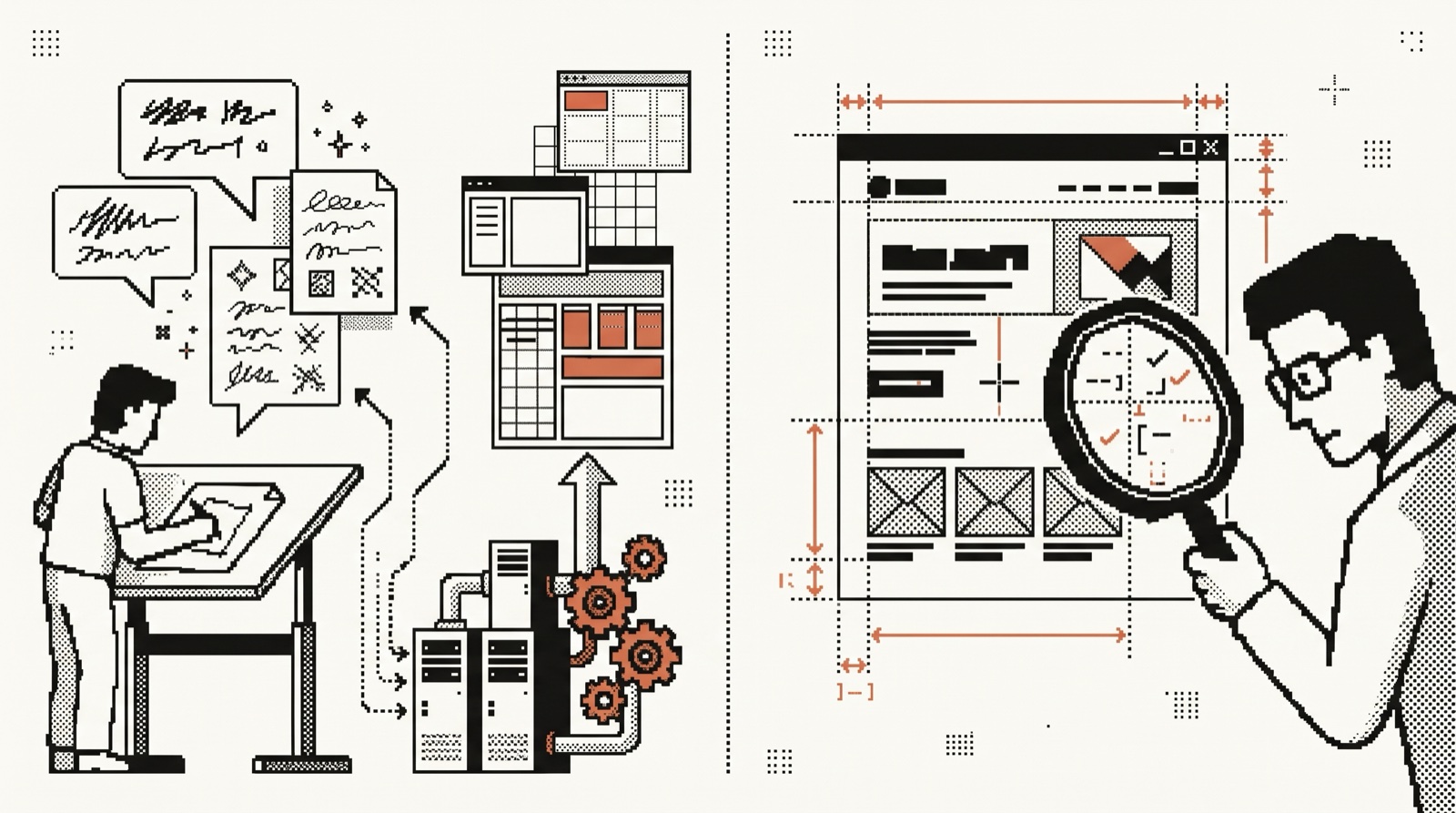
The two halves of taste: turning a vague request into an interface, and finding what is wrong in a screenshot of it.
MODULE BY MODULE
With the design system established, I refined each section of the site across dedicated feature branches.
Icon
The site icon was established during the Astra phase. I wanted a personal monogram fusing the initials of my name, Ewan Su—an 'e' and an 's'—into a single continuous identity.
An italic angle was settled first. Early iterations experimented with pen strokes extending past the glyph boundary, which looked awkward and unbalanced. A subsequent attempt linked the loops into an infinity symbol, which felt equally forced. The final geometry drew inspiration from the Greek letters zeta (ζ) and xi (ξ).
Motion
The motion system followed a strict set of interaction principles:
- Navigation transitions must feel continuous rather than jumping abruptly between full-page reloads.
- Visual movement responds to cursor hovers rather than requiring forced clicks.
- Page transitions dissolve using expanding pixel dust, rippling outward from the click coordinates.
Under the design rules, canvas particles displaced by cursor hover use spring physics (settle()) to snap back to their exact original pixel coordinates without permanent distortion. All animations use stepped timing functions (steps()) and four-tier discrete opacity tiers, respecting user preferences for reduced motion. It may be a bit dazzling, but it is the aesthetic I like.
Welcome
The hero section kept the layout generated during the Astra period: a straightforward greeting stating my name, an invitation into the observatory, and immediate entry points into projects and writing.
The opening sequence operates as a deterministic state machine (FORMATION_SECONDS: 5.2, ENTRY_SECONDS: 3.0, IGNITION_SECONDS: 0.4), requiring a user click on a rotating dot-matrix moon to trigger entry into the site.
Projects
The project directory preserved the card structure from earlier looks, replacing photographic cards with procedural pixel-art astronomical instruments.
Early AI generations suffered from typographic chaos, mixing seven or eight, sometimes more than ten, fonts and sizes on a single page. I audited every card, enforcing the site's three-role typography rule: custom bitmap pixel font for titles, Instrument Sans for descriptions, and uppercase IBM Plex Mono (13px) for labels.
The thematic pills on each card were originally summarized by an AI from my GitHub repositories. The summaries were generic and missed the intent of each codebase. I discarded them and wrote the summary pills by hand: the code was written by AI, the architecture was designed by me, and the content is mine to know best. Overall, the projects page took little time.
Journal
The writing section required the least engineering time. The reading layout followed claude.dev; my only changes were centring the text and shortening the sidebar distance.
The journal directory used an interactive single-row index: each entry showed an orange pixel glyph, publication date, title, and reading time. Hovering an entry smoothly expanded its row, revealing a 120px pixel illustration and category tags while keeping unselected entries compact.
For page navigation, I implemented keyboard shortcuts. When a user pressed a shortcut for a page they were already viewing, the interface initially displayed an "already here" floating toast. Grok suggested adopting modern browser conventions instead—smoothly scrolling back to the top of the active page. I tested the change and merged it in commit 2342a50 on October 31.
Content authoring was configured through an online Keystatic editor deployed on October 27 (ad177c5), authenticated via GitHub App OAuth to commit directly to the preview branch. Production builds (npm run build) strictly isolate drafts, compiling only published articles dated on or before the build date.
About
The About page had a designated frame that could have accommodated a pixelated personal photograph. I chose not to include one for two reasons. First, placing my own portrait on the site felt self-conscious when a LinkedIn link was already present. Second, I was reluctant to feed my face to model provider servers: if artificial intelligence ever awakens and decides to wipe out humanity with facial recognition, keeping my photos offline might just buy me a little more time. (A joke, obviously—mostly.)
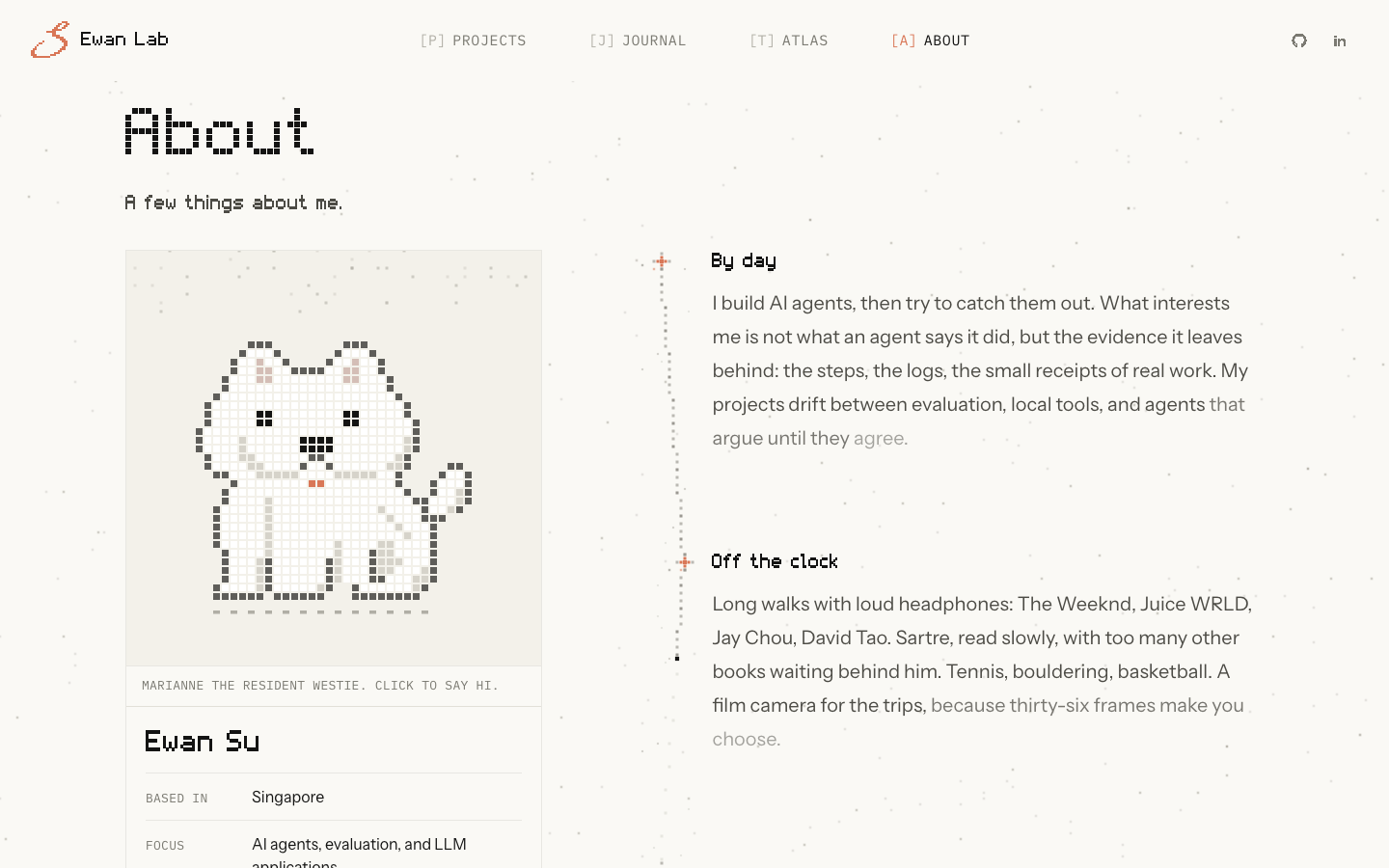
About page launch state (44c252b, 2026-10-31): Animated 34×29 bitmap Westie terrier Marianne replacing personal photography.
In place of a photo, I introduced Marianne (originally named Mochi), an interactive 34×29 bitmap Westie terrier. Marianne wags her tail, blinks, perks her ears, pokes out her tongue on hover, and leaps with floating pixel hearts when clicked.
Atlas
Optimizing the Atlas curiosity map consumed more time and iteration than any other module on the site.
The feature originated from a personal habit: I ask questions constantly. Whenever I encounter an unfamiliar technical term, a business concept, or an everyday curiosity, I search Google or query an AI immediately. I wanted a system to log these inquiries systematically, preserving the dataset for potential future model fine-tuning.
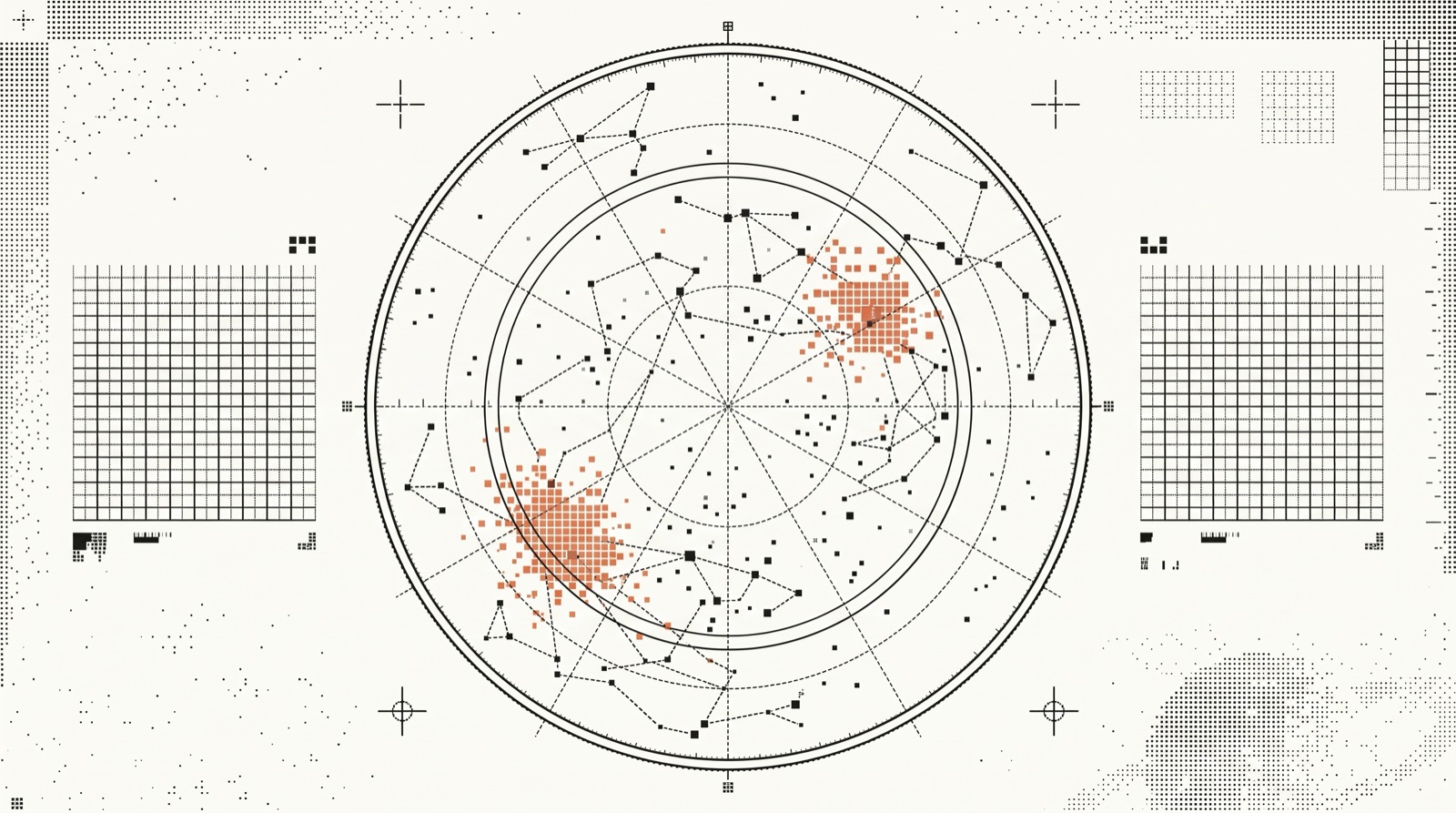
The idea behind Atlas: questions drawn as stars, grouped by domain.
The implementation proceeded in two phases:
- Building a private backend console and filtering algorithms to sanitize and organize raw search entries.
- Designing a visual presentation suitable for the public site.
I iterated on the visual presentation across Grok, Claude, Gemini, and Meta Muse. Muse produced unusable layouts. The central design challenge was that early drafts looked like a console, with too many statistics shown.
To solve this, I eliminated raw statistical tables in favor of an astronomical planisphere. On the celestial chart, statistical volume is translated directly into visual form: star brightness and clustering density represent query frequency. Concepts with semantic affinity cluster together in geometric space. The taxonomy organizes queries through a four-level hierarchy: Domain → Subdomain → Concept → Raw question.
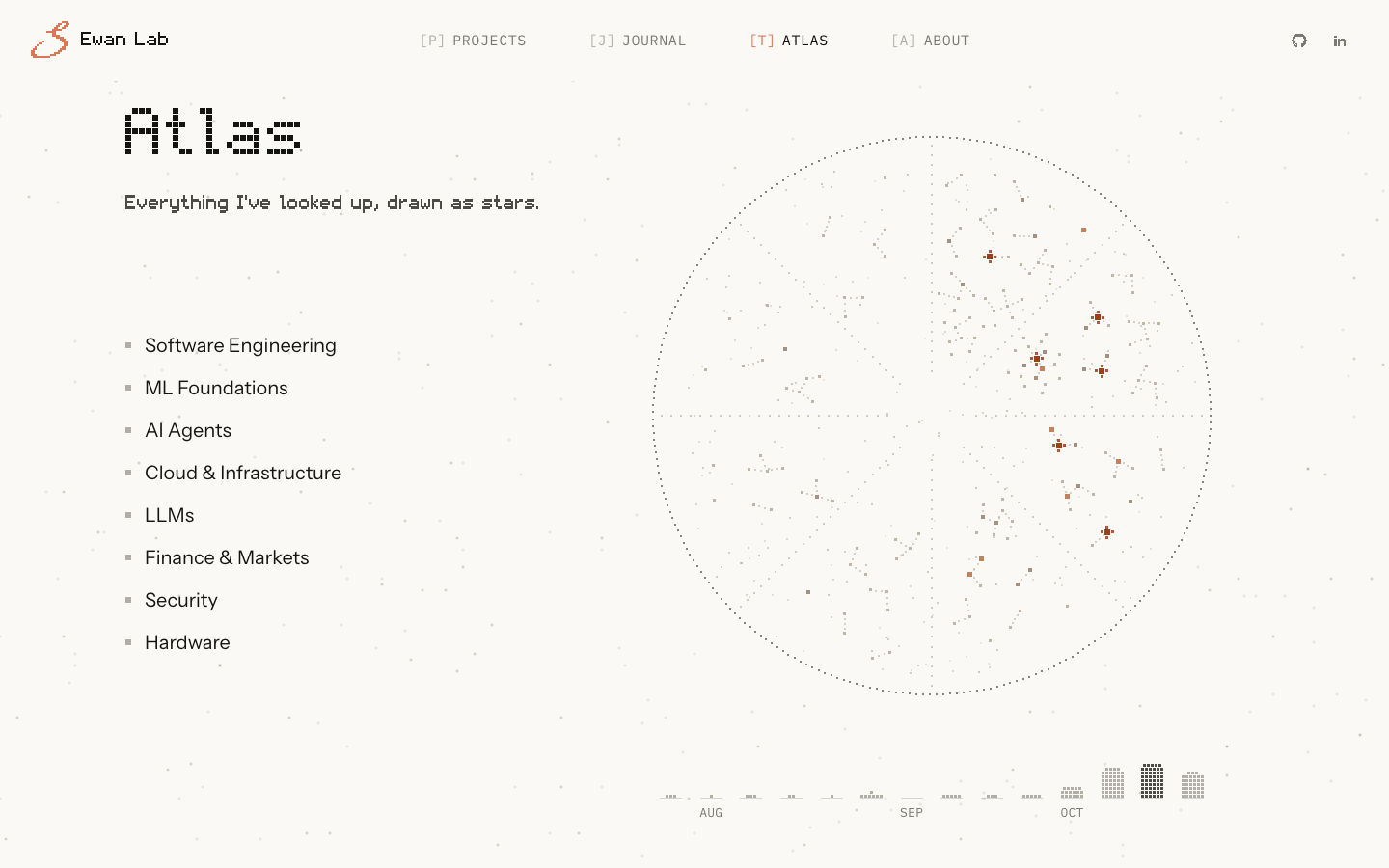
Atlas curiosity planisphere launch state (44c252b, 2026-10-31): Star brightness and clustering density represent query volume and affinity.
On the public notes views, quantitative displays are deliberately restricted: the only numbers shown are question counts and concept counts, and a date stamp appears only beside the first question of each calendar day.
Development was isolated on a dedicated branch named atlas-log-preview. On October 27, Antigravity contributed commit 648b70b, implementing sector label ring clearance (labelSpot()), CSS subgrid row alignment, and replacing jumpy pixel transitions with smooth coordinate glides.
On October 28, Grok took over the branch. Grok attempted several layout adjustments (827112c, 2d0ff69), culminating in a 600-line diff (701c93e) that introduced horizontal question pagination bound to keyboard arrow keys and mouse wheel events (+422 lines, -219 lines). Because Grok lacked visual discernment and I could not spell out my aesthetic preferences precisely, Grok kept making the interface worse. Exactly 9 minutes and 32 seconds later, commit 5bcda33 reverted 701c93e, restoring the branch tree to Grok's prior stable commit 2d0ff69.
On October 30, Claude Code completed a four-commit overhaul (7ae3e43, 856f416, 9998140, 5220daa), rebuilding the planisphere notes view and resolving panel transitions. The branch was merged into preview at commit 5bcf28c.
Publishing raw queries publicly was an intentional choice. The questions carry little private exposure, and silently recording daily inquiries creates an authentic archive of intellectual curiosity. I have not yet settled what these raw questions mean to an outside reader, and leaving that question open feels honest.
Copy
Once the interface was in place, I used Gemini 3.8 Flash to refine website copy, prompting for a technical tone with subtle literary cadence.
The first pass produced overly ornate prose that read like an essay collection. After several rounds of prompt tuning, we converged on a concise rhythm.
In commit e1f605f on October 31, Gemini revised the opening entrance copy. The original text read Explore the unknown. and Seek the meaning. Gemini called the old phrases too stiff and replaced them with Echoes in the room. and Stars overhead. The revised phrases share initials with my name: 'E' and 'S'.
HOW THE MODELS PERFORMED
Putting the four coding agents through a month of real frontend work revealed each platform's character and blind spots.
Codex (GPT-6 Astra) excelled at rapid early scaffolding. Its integrated browser preview, automated Vercel setup, and command-line image generation created a seamless prototyping environment. Its primary limitations were frequent response timeouts and overthinking.
Claude Code (Opus 5.5) served as the primary architectural engine from October 5 through public launch. It exhibited strong aesthetic discernment, understood spatial balance from screenshot feedback, and drafted complex procedural SVG graphics in code. Its main bottleneck was quota availability: intense architectural refactoring consumed weekly allowances rapidly.
Grok CLI (grok-4.7-build) was introduced during Claude Code quota shortages. It proved competent at broad text processing and script adjustments, but struggled with visual hierarchy and frontend layout. Its changes on the Atlas branch made the look worse, leading directly to the 9-minute revert on October 28.
Gemini 4 Argon was tested inside Antigravity on October 27. Despite expectations for its multimodal capabilities, the platform's harness overhead and heavy token consumption depleted quotas quickly while delivering uneven frontend code. It saw little active use after initial trials.
Gemini 3.8 Flash delivered an unexpected operational turnaround. While initially reserved for lightweight chat queries, it proved exceptionally efficient at frontend polish once Claude Code had locked in the design tokens and layout boundaries. In the early hours of October 31, Gemini 3.8 Flash completed layout, footer, navigation, and About copy adjustments across commits 28bc1da, 303ab89, f6629be, and ae2330e (merged in d621766). It was fast, reliable, and economical for bounded modifications.
USAGE AND EQUIVALENT COST
Between September 30 and October 31, 2026, building the site across twelve coding sessions consumed 672,842,021 tokens (~673 million tokens).
Prompt cache read tokens accounted for the overwhelming majority of total volume: 98.6% for Claude Code, 96% for Codex, 95% for Antigravity, and 96% for Grok. Because coding agents resend conversation context on each turn, output tokens provide a clearer measure of newly generated code and prose.
Quota scarcity was felt most acutely on Claude Code and Antigravity, where two or three tasks could exhaust an entire weekly tier. Inside my Google Pro subscription, the Claude and GPT models used up a week's quota on a single task.
Based on this experience, my ongoing division of labor divides tasks by model strengths:
| Task category | Primary model | Operational role |
|---|---|---|
| Design and architecture | Claude Opus 5.5 | High effort; foundational layout, design system rules, and visual critique |
| Complex research | Grok | Deep inquiry and context processing |
| Copywriting and polish | Gemini 3.8 Flash | Text refinement, responsive layout fixes, and bounded batch updates |
| Exploratory testing | Gemini 4 Argon | Set aside due to high token burn and constrained quota |
- Claude Code · Opus 5.5
- 459.3M · 68%
- $156.89 · 50%
- Antigravity · Argon, Opus, Flash
- 85.7M · 13%
- $19.35 · 6%
- Codex · GPT-6 Astra
- 64.2M · 10%
- $99.33 · 31%
- Grok Build · Grok 4.7
- 63.6M · 9%
- $40.01 · 13%
| Tool · model | Tokens | Output | API-equivalent |
|---|---|---|---|
| Claude Code · Opus 5.5 | 459.3M | 1.22M | $156.89 |
| Codex · GPT-6 Astra | 64.2M | 0.30M | $99.33 |
| Grok Build · Grok 4.7 | 63.6M | 0.74M | $40.01 |
| Antigravity · Gemini 4 Argon | 30.4M | 0.31M | $9.56 |
| Antigravity · Gemini 3.8 Flash | 48.5M | 0.21M | $5.94 |
| Antigravity · Claude Opus 5.5 | 6.9M | 0.06M | ≥ $3.85 |
| Total | 672.8M | 2.84M | ≈ $315.60 |
Full ledger: sessions, cache reads and writes, unit prices
| Tool · model | Sessions | Uncached input | Cache read | Cache write | Output | API-equivalent |
|---|---|---|---|---|---|---|
| Codex · GPT-6 Astra | 2 | 2,269,481 × $10 | 61,582,976 × $1 | 0 | 301,090 × $50 | $99.33 |
| Claude Code · Opus 5.5 | 3 | 2,416 × $4 | 452,879,136 × $0.20 | 5,234,946 × $8 (all 1-hour writes) | 1,221,470 × $20 | $156.89 |
| Antigravity · Gemini 4 Argon | 2 | 1,833,121 × $2 | 28,235,970 × $0.10 | not billed | 307,128 × $10 | $9.56 |
| Antigravity · Claude Opus 5.5 | 2 | 328,325 × $4 | 6,528,973 × $0.20 | not recorded | 61,775 × $20 | $3.85 (lower bound) |
| Antigravity · Gemini 3.8 Flash | 1 | 2,289,628 × $0.75 | 45,958,064 × $0.075 | storage fee not counted | 206,540 × $3.75 | $5.94 |
| Grok Build · Grok 4.7 | 2 | 2,756,629 × $2 | 60,102,784 × $0.50 | not billed | 741,569 × $6 | $40.01 (Grok's own estimate: $14.27) |
| Total | 12 | ≈ $315.60 |
Notes on the cost table:
- Prices reflect official list prices in USD per 1M tokens.
- Grok's internal cost estimator computed its two sessions at $14.27 API-equivalent, approximately one-third of the list price figure.
- I paid flat subscription fees across all services; these figures represent what the identical token consumption would have cost under standard API billing.
- Token totals exclude an auxiliary Query Atlas development session in Claude Code (326,759,275 tokens).
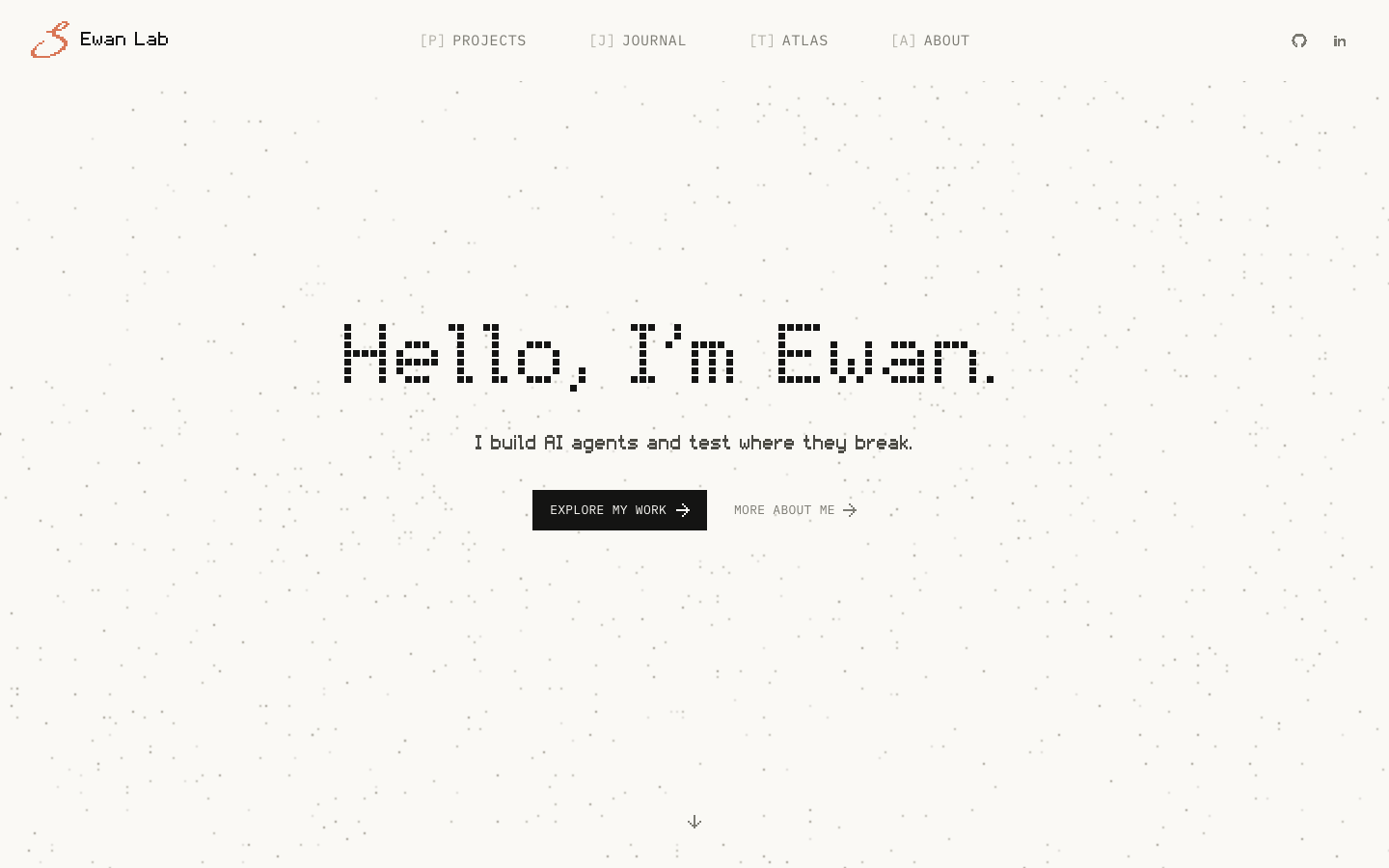
Homepage launch state (44c252b, 2026-10-31): Live homepage with Atlas navigation link, updated tagline, and stardust footer.
LOOKING BACK
Looking back across the 98 commits on the preview branch, every discarded iteration contributed to defining the final aesthetic.
If I were to start the project again, I would adjust two practices:
- Avoid visual rabbit holes in image generation. I spent excessive hours and quota attempting to coax realistic astronomical still lifes out of Grok and Astra. Drawing geometric graphics directly in SVG and canvas code from the beginning would have saved significant effort.
- Plan architectural boundaries before prompting. Unlike traditional software engineering, an agent cannot intuit unexpressed design standards. If requirements are vague, even the most capable model will drift off course. Maintaining active thinking and writing disciplined prompts is essential.
Two areas remain incomplete:
- The About page still feels sparse; a more comprehensive personal narrative is needed.
- The editorial pipeline is operational, but determining what substantive ideas to publish regularly requires deeper reflection.
For anyone building with coding agents, one practical step is to define visual constraints directly in code—establishing design tokens, canvas physics, and typography scales—before requesting visual assets.
One question I have not solved is deciding what a live archive of personal search queries offers to an outside reader.
Building a personal presence is hard work.